




BASIC KNOWLEDGE- GIA
BASIC KNOWLEDGE- GIA

WHERE GIA STANDS TODAY (STANDARDS)
GIA (Gemological Institute of America) was founded by Robert M. Shipley in 1931 as an independent non-profit organization. Its purpose was to provide guidance, standard, research and education to consumers and bring standardization to the gemstone industry. Before GIA, buyers would often have to rely solely on the words of jewelry sellers, which are often misleading.
Fast forward to today, GIA is one of the leading sources for knowledge, standard and education in gemstones and jewelry. Till today, they are following the vision of Robert M. Shipley, to have greater transparency and standardization in diamond grading, and to provide better consumer protection. Through research, education and unbiased gem grading & analysis, GIA strives to protect consumers by setting and upholding international quality standards.
GIA BELIEFS
GIA strives to be consistent in their gradings and standardizing the process in all its laboratories located in different parts of the world.



JP NOTES
GIA is today the most recognized and renown certification due to its longstanding and consistent grading that has not wavered over the years. Certain laboratories weaken their strictness to attract more submission from cutters and jewellers to profit. Jewellers used to bribe individuals in certain laboratories to give their diamonds a higher grade. We have found that GIA has never partook in any such activities over the years in our time in the diamond industry.
TYPES OF GIA CERTIFICATES
For natural mined diamonds, GIA has 2 types of certificate report; Diamond Dossier and Diamond Grading Report. GIA only grades diamonds that are 0.2ct or above.
The Diamond Dossier is a smaller version of the GIA report, that is usually used for diamonds under 1 carat (e.g. 0.2-0.99 carat). It shows the basic gradings of a diamond, including its Cut, Carat, Color and Clarity grade, as well as its proportions.
The Diamond Grading Report (A4 size) is usually used for diamonds that are 1 carat or above. For a higher service fee, GIA is able to print this Diamond Grading Report for lesser carat weight diamonds as well. This is why, you might occasionally come across 0.8-0.9 carat diamonds with these larger certificates. The main difference (besides the size) between these 2 GIA certificates, is the Clarity Plot diagram in the Diamond Grading Report. The location of the inclusions is plotted out on a front and back diagram of a diamond, to map out the location of the inclusions in the diamond. Other than that, the rest of the information are exactly the same.
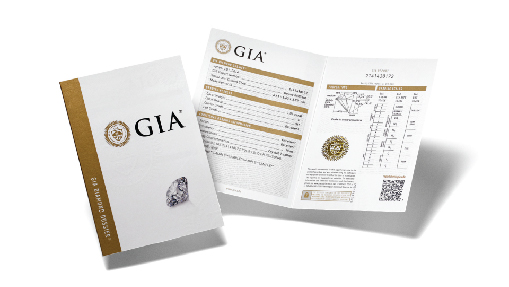
GIA Diamond Dossier
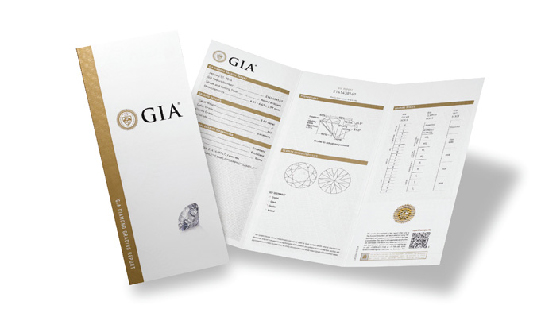
GIA Grading Report
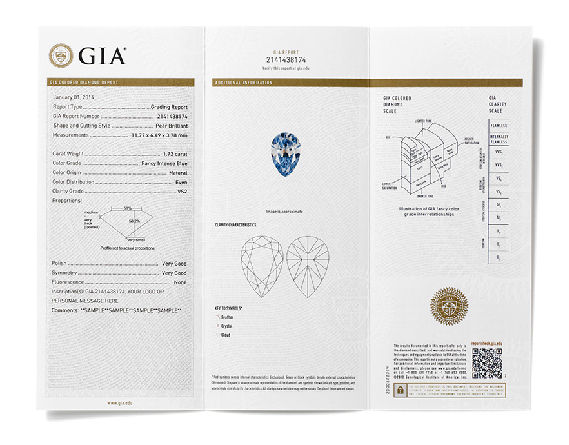
GIA Colored Diamond Report
For Fancy colored diamonds, such as pink, blue, green, black, etc. GIA has a Colored Diamond Report. This separates it with the white diamonds (D-Z Colors). Essentially, diamonds that have a high saturation or tone that goes beyond the ‘’Z’’ Color grades, are categorized as a fancy colored diamond, and are given a Colored Diamond Report instead. In the Colored Diamond Report, the intensity and distribution of the Color is graded.

JP NOTES
In early 2000s, counterfeit GIA reports together with High Pressure High Temperature (HPHT) diamonds were flooding the market. GIA released a free online service (www.gia.edu/reportcheck) to validate their certificates and if doubts still remain, GIA advice people to submit their diamond along with its original report to their laboratory to be re-assessed.
WHAT IF I LOST MY GIA CERTIFICATE? CAN I RE-PRINT IT?
GIA has a very strict policy on printing the original GIA certificate copy. At any point of time, there can only be 1 printed original report. GIA takes this very seriously, to prevent any possible fraudulent or tampering with their report. If you have misplaced or damaged your GIA certificate, there are some options that you can take:
- You may download the softcopy of your GIA Report on their website https://www.gia.edu/report-check-landing By entering your GIA report number, you would be able to retrieve and download a softcopy (PDF) of your certificate, and re-print it out yourself.
- If you’re original GIA certificate is damaged, you may submit your original GIA certificate to one of GIA lab locations. They would verify the authenticity of your report, and re-print a new original copy, for a small service fee. The damaged report will be kept with GIA, while they send you your new report. There can only be 1 original copy in circulation.
- If you have lost your GIA report, and would like to obtain a new original copy, you would require to submit your diamond back to one of GIA’s lab locations, for them to re-grade and verify your diamond. GIA only accept loose diamonds for gradings. Hence, you would have to unmount your diamond from your jewelry, before sending it to GIA. GIA would charge a re-grading and re-printing service fee, where the cost would vary according to the carat weight of your diamond. In your new original GIA Report, there would be a remark that clearly states that this is a ‘’duplicate copy’’. GIA has a strict policy that there will never be 2 of the same original certificates in circulation.
- If you have lost your GIA report, and would like to have a brand-new GIA original copy without the ‘’duplicate copy’’ remark, you would require to re-certify the diamond. The process will be similar, where you would need to unmount your diamond from your jewelry piece. However, you would require to polish off your existing laser inscription number on your diamond, and re-submit it to GIA as a new diamond to certify. This process can be lengthy, and may take 2-3 months. In addition, there is a risk that GIA would not give your diamond the same grading as your previous report, as it would pass through a new grading process. Although GIA tries their best to maintain consistency in their grading services, their gradings may still vary due to different graders involved.
JP NOTES
A common practice amongst private jewellers worldwide, especially drop dropship jewellers who claim to carry thousands of diamonds in inventory, would send a copy of a GIA certificate printed from online to show a client along with a substituted diamond of higher quality. An unexpecting consumers would place a deposit or payment for their diamond ring, thinking that they bought a good quality diamond for 40% below the market price. Once the swapped diamond is set into the ring, the jeweller would show them the GIA number to verify.
*IMPORTANT
To protect yourself, always check the GIA inscription number on the diamond you are purchasing immediately when assessing the certificate. This has been happening on a daily basis when clients reach out to us, they provide us a GIA number and saw the diamond at a jeweller. But when we check the source of the diamond, the diamond has never left the cutting facility before.
- Paul Hung 2020
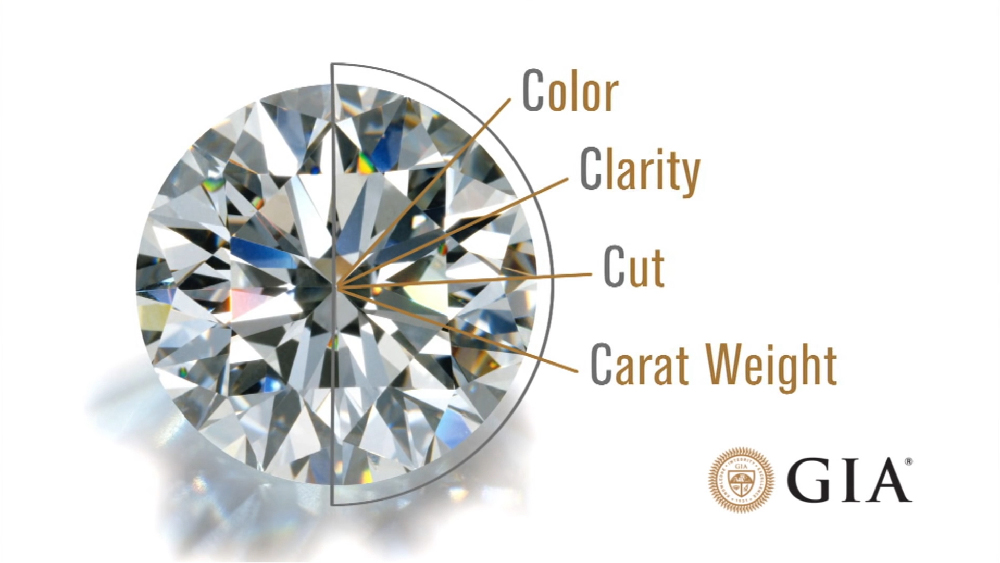
HOW GIA GRADES DIAMONDS?
GIA has an elaborate grading process to maintain objectivity and independency in their reports. Every diamond goes through a strict anonymity procedure, where the graders would not know the identity or organization that submitted the diamond for grading. This is to prevent biasness or bribery in their grading process.
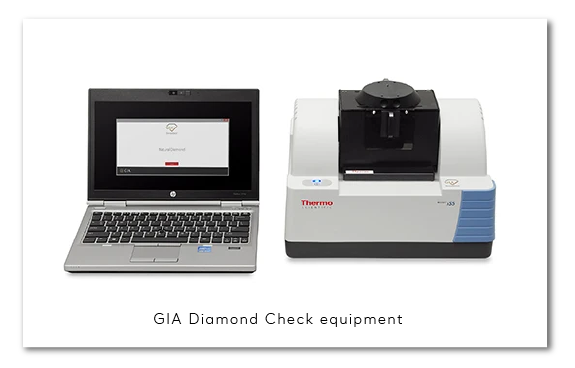
All items submitted to GIA for their diamond grading services is first examined with the GIA Diamond Check equipment (https://store.gia.edu/collections/gem-identification/products/gia-diamondcheck), to determine if it is a natural mined diamond.
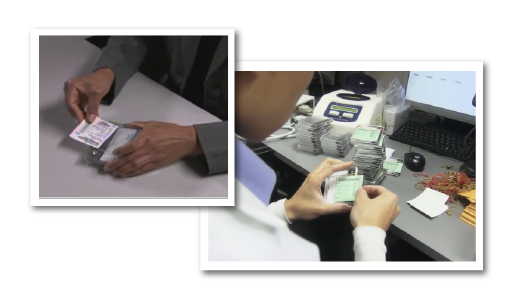
When GIA lab receives a diamond, it is placed in a custom transparent storage case, where any references to its owner is removed. A unique bar-coded label is used to identity and track its grading process. Hence, only the diamond’s information is available in its packaging.
With 11 grading laboratories worldwide, GIA tries their best to maintain the same level of service and standards in all of their locations. All diamonds are consolidated and distributed from its Inventory Control Department, which serves as a hub to randomly distribute diamonds to graders. This is to ensure independence and impartial grading in their process.

JP NOTES
Over 100,000 diamonds that we have sold over the last decade, we have found inconsistency in color, clarity, fluorescence and proportions. Albeit the inconsistency can be 1-2 grades off, it does not happen very frequently. This is due to different laborites having different machineries, sometimes with different tuning. On top of that, their grading system incorporates human interpretation which can vary from one to another. This results in certain inconsistencies.

ADVICE
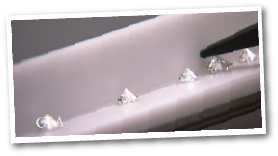
When buying a diamond of any certification, always analyze multiple diamonds of same grades under appropriate lighting sources (not jeweller lights). E.g. If looking for color inconsistencies, view them table face down, and request for multiple diamonds of the same color grade for comparison. This would prevent cut quality from interfering with the actual body color of a diamond.
- Eugene Seah, 2020
HOW GIA MEASURES CARAT WEIGHT?
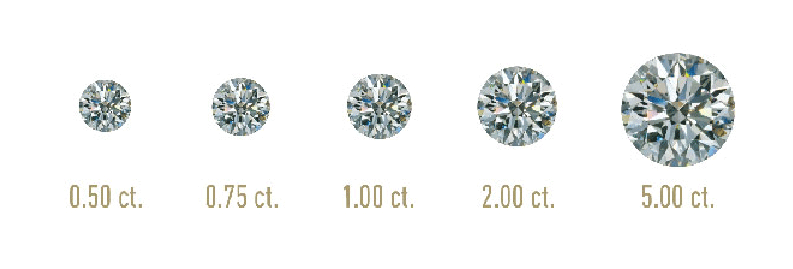
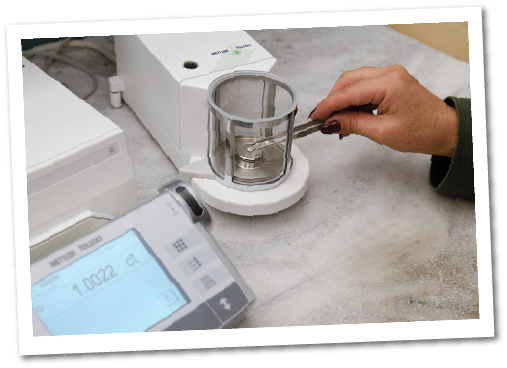
GIA uses an electronic micro-balance that captures the weight of a diamond to the fifth decimal place. It is then rounded down to the second decimal place by the eight hundredth. For example, if a diamond’s carat weight is 1.00888 carat, it will be rounded down to 1.00 carat on the GIA diamond report, while a 1.00999 carat will be rounded up to 1.01 carat.
JP NOTES
Have you heard about the diamond magic numbers? JANNPAUL does not carry certain flat carat weights due to diamond pricing brackets. To find out why, click here.
HOW GIA GRADES COLOR
Before the D-Z Color Grading Scale was developed by GIA, jewellers were using a variety of systems that was loosely applied. Some used alphabets (A, B, C), numbers (1, 2, 3), Roman numerals (I, II, III) or vague descriptions such as ''blue white'' or ''gem blue'' to describe diamond colors. This created a lot of confusion for diamond buyers as none of these systems were regulated or standardized, and was highly inaccurate. Hence, when GIA wanted to create a fresh start in their standardized Color Grading Scale, they did not want it to be associated with other color systems and started with a new letter ''D''.
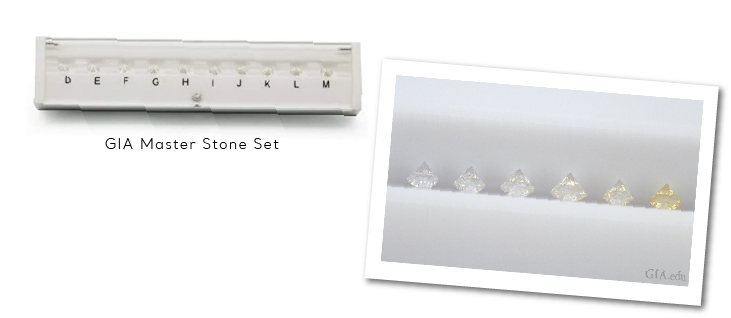
GIA grades the Color of a diamond visually in a standardized viewing environment. Each diamond is examined independently by a Color grader that submit their individual opinion into the system, without knowing the opinions of other graders. The final grade is determined when there are sufficient agreeing opinions.
GIA determines a diamond's color, by placing the table face down, under a controlled lighting condition (GIA Diamond Dock) under diffused fluorescence lights. The diamond is then compared against a set of ''master stones'', that are preset into its corresponding D-Z Color grades. This comparison methodology is used for all diamond color grading, by matching the diamond's saturation (intensity) and tone (lightness or darkness) to the closest master stone.
JP NOTES
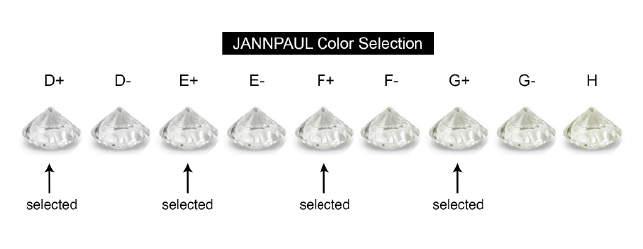
Master Stone set helps to distinguish the Color grade of the diamond by matching it to the closest Color. However, it does not distinguish between the upper and lower scale of each Color Grade. For example, if a diamond's Color falls in-between F and G in the Master Stone set, it is up to the graders to decide which tier the diamond should fall into. As a result, within each Color grade, there can be an upper G+ or lower G-. In JANNPAUL, we only select the upper range of each Color grade, such as D+, E+, F+ and G+ for higher values for our client without paying a premium for it.
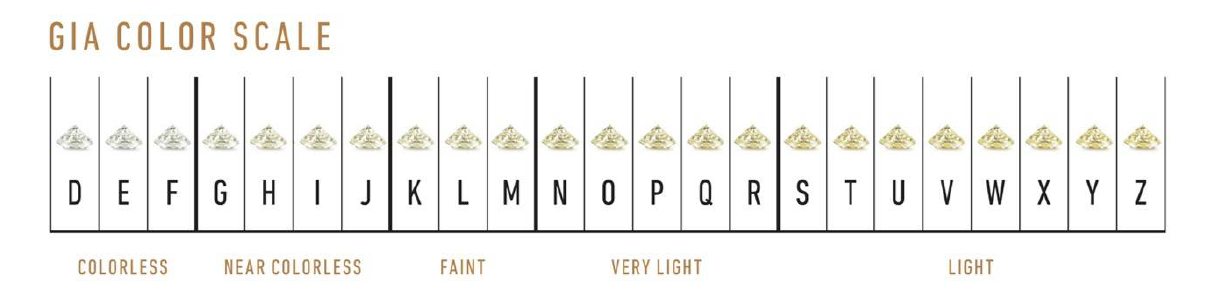
GIA Color grading scale starts with D, being the most colorless, which continues down to the last letter Z, which has the most presence of color, such as yellow or brown. This is measured by the visual comparison of the saturation and tone of the diamond, against the master stones.
JP NOTES
When GIA grades the Color of the diamond, they only grade it by its tone and saturation, but not its hue Color. What this means is a ''G'' Color diamond might have a yellowish, brownish, greenish or grayish hue. For more information, you may ready about it here.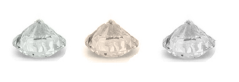
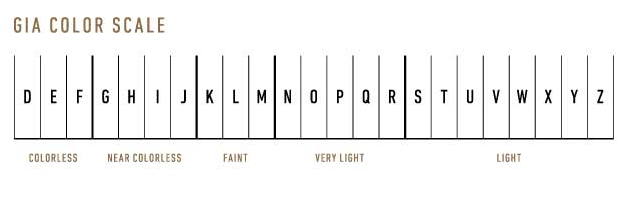
There are a total of 23 Color grades on the GIA Color Scale, that are subdivided into 5 categories:
- Colorless (D-F)
- Near Colorless (G-J)
- Faint (K-M)
- Very Light (N-R)
- Light (S-Z)
Generally, the more colorless, the more valuable and desirable your diamond is.
JP NOTES
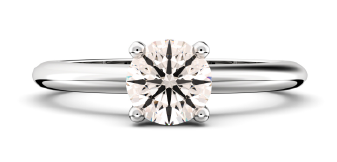
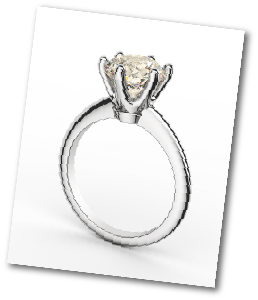
JANNPAUL only carries diamond Colors of G and above, as once it reaches H Color of below, the tinge of color in the diamonds becomes more noticeable, especially when you set it on an 18k white gold or platinum setting.
HOW GIA GRADES CLARITY
Before GIA introduced their Clarity Grading scale, jewellers were using loose terms to describe the clarity of a diamond, such as ''loupe clean'' or ''pique''. This was highly subjective, depending on the jeweller’s individual standard and interpretation. Hence, it was very confusing for consumers as there was no standardized way of grading a diamond's clarity.

JP NOTES
Even today, descriptive words such as ''eye clean'' are often abused as different jewellers have different standards of what is an eye clean diamond. Depending on the viewing distance, lighting environment and eye sight, jewellers loosely label the term eye clean on a diamond. For example, some inclusions are more visible under certain lighting conditions (white light), but are not visible under other lighting conditions (direct light), are still labelled as ''eye clean''. Some jewellers also classify milky diamonds as ''eye clean''.
- Casey Lai 2020
GIA grades the clarity of a diamond by using a 10x magnification loupe from a distance of 20-25cm. The clarity grader would first examine the diamond to locate its clarity characteristics and for any clarity enhancement treatments, such as fracture filling or laser drilling.
The Clarity grader would submit their individual opinions of the clarity grade in the system, where the final grading of the diamond would be the most agreed upon grade. The effect of a clarity characteristic on the clarity grade is based on its size, number, position, nature and color. However, this is prone to human error as no inclusions are identical, and it is up to the clarity graders own interpretation.
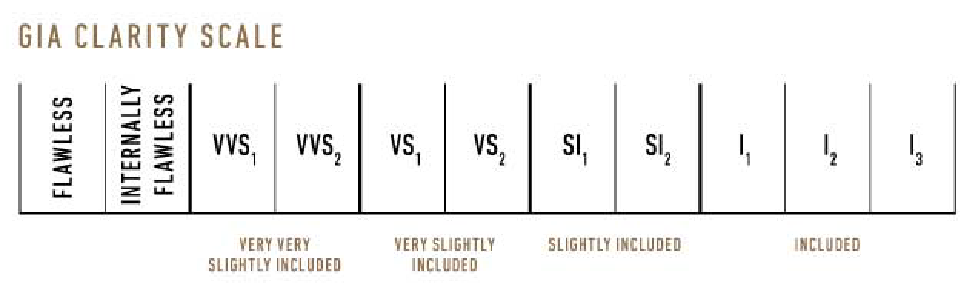
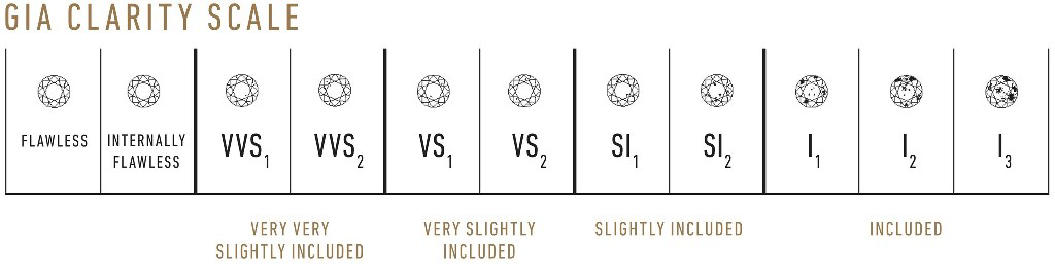
GIA categorizes the Clarity Scale as:
FL (Flawless)
IF (Internationally Flawless)
VVS1 (Very Very Slightly Included 1)
VVS2 (Very Very Slightly Included 2)
VS1 (Very Slightly Included 1)
VS2 (Very Slightly Included 2)
SI1 (Slightly Included 1)
SI2 (Slightly Included 2)
I1 (Included 1)
I2 (Included 2)
I3 (Included 3)
JP NOTES
Certain clarity characteristics and locations may cause durability issues in a diamond, such as chipping or cracking. Most often, this is found in VS1-I3 range.
Advice: GIA does not consider how the diamond is going to be set by the jeweller, nor if the consumer is going to wear it everyday or occasionally. Potential clarity characteristics that pose a danger to chipping or cracking may be present. Always request for your jeweller to check if any inclusions such as feather, needle, chip, crack, or other surface fracture does not cut across delicate areas of the diamond, E.g. girdle, culet or aligning facets. The last thing you want for your diamond is to have a chip or crack.
- Eugene Seah 2020
HOW GIA GRADES CUT
Grading the Cut of a diamond is one of the most challenging and comprehensive research that GIA conducted. The term ''Cut'' is a very generic word, which can refer to a diamond's shape, proportions, light performance or beauty. In addition, beauty can be subjective, as individuals may have different personal preferences.
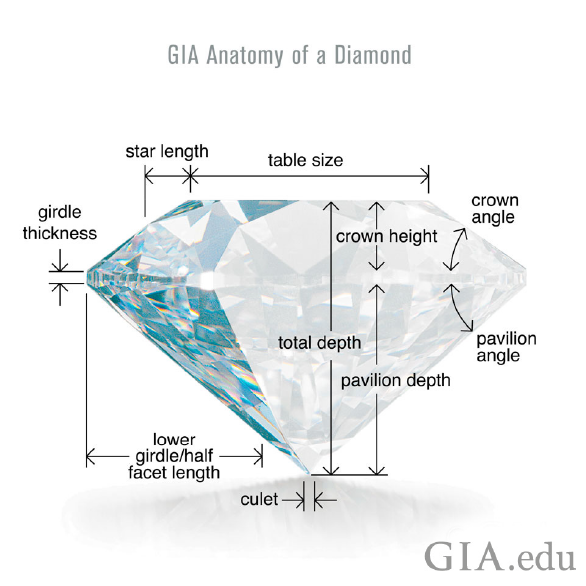
GIA developed their Diamond Cut Grading System for only Round Brilliant Cut diamonds. It is a predictive system, that is based on science (proportions) and visual observations (survey).
JP NOTES
GIA does not grade the Cut for fancy shape diamonds as they believe there is not an internationally accepted system to evaluate the appearance of fancy cut diamonds. However, with the new generation of fancy shape diamonds with Hearts & Arrows, the Cut can be evaluated through systems such as forward and reverse ray tracing, tilt evaluation, equal distribution of brightness and contrast (brilliance), spread, etc. As such, more technologically advanced labs such as the AGS do grade the Cut and Light Performance for Fancy shaped high light performance diamonds, which can surpass even the best of the traditional Rounds in terms of brilliance, fire and scintillation.
- Paul Hung 2020
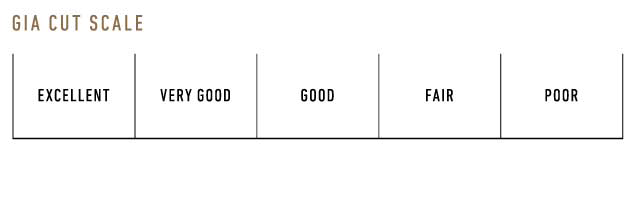
GIA uses a proportioned based grading system to determine a diamond's Cut grade. They use an optical measuring device to get a 3D image of the diamond, to extract its measurements and average proportions. They then use these proportions to determine if a diamond falls under their Excellent, Very Good, Good, Fair or Poor Cut grade.
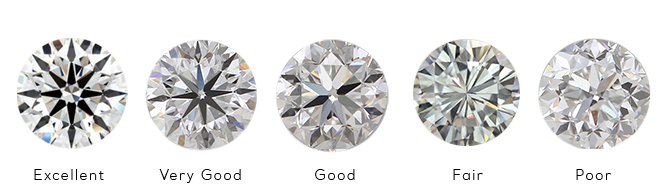

The second approach they use is the GIA Diamond Dock to visually grade a diamond. GIA did an extensive survey, where over 70,000 observations was conducted with diamond manufacturers, dealers, retailers, jewellers and consumers to view over 2,300 diamonds under the Diamond Dock to determine the popular preference and taste of what makes a diamond desirable and eye-catching.
When GIA developed their Cut grading system, they used people to conduct observations on real diamonds, of what they thought was the best-looking diamond. By collecting these data, they used these statistics to formulate their Cut scales and thresholds.
JP NOTES
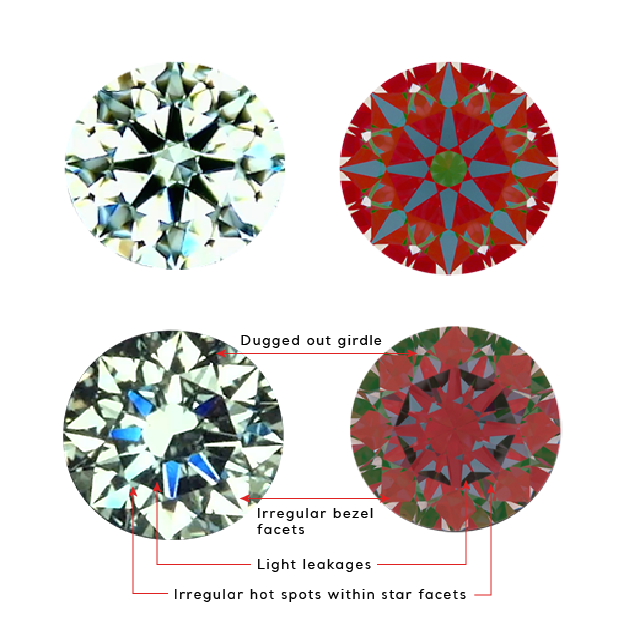
The GIA Diamond Dock is a controlled lighting environment, that uses a grey colored background. All diamond analysis was analyzed under this grey and white environment. However, this does not reflect real life scenarios of when a diamond is worn or set on a jewellery. Diamonds with massive light leakages are not obvious under the GIA Diamond Dock, as it shows the grey background of the Dock. However, when a diamond is set on a colored metal (e.g. rose or yellow gold), these metal colors would seep into the diamond, causing the diamond to appear darker. As a result, diamonds with very poor light performance are still able to achieve a GIA ''Excellent'' Cut grade.
- Casey Lai 2020
HOW GIA GRADES LIGHT PERFORMANCES
GIA does not grade the light performance of a diamond. GIA finds that the term ''Light Performance'' is a vague term in the diamond trade. They believe that the beauty of a diamond is in the eye of the beholder and question the definition of ''light performance'', as it refers to what most observers loves which can be personal taste.
Refer to: https://www.gia.edu/gia-news-research/gia-researchers-evaluate-light-performance-diamond-cut
JP NOTES
In the article, GIA writes about poor cuts having poor distribution of light and dark areas, forming a pattern that most find very unattractive. This in essence is actually called light performance. A simple use ot the ASET can determine these dark and bright areas immediately, which is rather contradicting as a side by side comparison of a poor cut diamond determined by GIA observation based on brilliance is revealed in tools such as the ASET. However, we do agree that the light performance term is heavily abused in the industry. But this does not mean GIA should not adopt and research into this area. We know Robert M. Shipley would.
- Paul Hung 2020
JP NOTES
GIA is correct that the term ''Light Performance'' is often abused in the diamond trade as jewellers often misuse these terms to upsell their diamonds. As this term is unregulated in the industry, consumers can be easily mislead by this term. However, there are scientific ray-tracing tools such as the ASET (Angular Spectrum Evaluation Tool), which measures the light return of a diamond, that can be used to measure a diamond's light performance. In addition, there are several limitations in GIA observation surveys where the GIA Diamond Dock does not reflect real life situations when viewing a diamond. This may result in an inconclusive survey as a diamond's light leakages are camouflaged with the gray tray and dock.
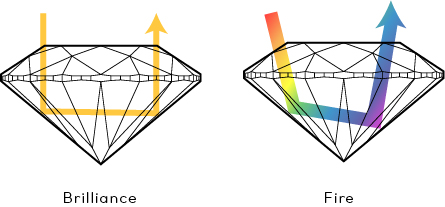
GIA believes that personal taste is an important factor of perceived light performance. This can only be further researched through a comprehensive survey of visual observations from individuals. However, they found that there are disagreements on what is most pleasing for a diamond and are unable to conclude on what truly classify a diamond's light performance, as there's no internationally agreed system to measure a diamond's brilliance, fire and scintillation.
GIA continues to avoid the use of the term ''light performance'' as believe it is not verified by sufficient observers to have a conclusive agreement, and the term is ambiguous amongst different jewellers.